
Wi-Fi frequency bands are the wireless signals your router uses to connect your devices to the internet. The two most common bands are 2.4 GHz and 5 GHz, and they differ in speed, range, and stability. The 2.4 GHz band covers a longer distance, while the 5 GHz band gives faster internet speed over a shorter range. Understanding these bands helps you choose the best Wi-Fi setting for smoother browsing, streaming, gaming, and everyday internet use.
What Is a Wi-Fi Frequency Band?
A Wi-Fi frequency band is the wireless signal range your router uses to send internet data to your devices. Instead of using cables, your router sends signals through radio waves, allowing phones, laptops, smart TVs, and tablets to connect to the internet. The most common Wi-Fi frequency bands are 2.4 GHz and 5 GHz.
In simple words, frequency bands work like roads for your internet connection. Some roads cover a longer distance but move more slowly, while others are faster but shorter. That is why choosing the right Wi-Fi band can improve speed, range, stability, and overall browsing experience.
What Is the 2.4 GHz Frequency Band?
The 2.4 GHz frequency band is one of the most widely used Wi-Fi bands because it offers better coverage over longer distances. It can pass through walls, doors, and furniture more easily, making it useful for large homes, offices, and rooms far from the router.
However, 2.4 GHz is often more crowded because many devices use the same band, including Bluetooth devices, microwaves, baby monitors, and nearby routers. This overcrowding can cause interference, slower internet speed, and higher latency, especially in busy areas.
What Is the 5 GHz Frequency Band?
The 5 GHz frequency band is a faster Wi-Fi band designed for better speed, smoother streaming, and lower latency. It is ideal for activities like online gaming, HD video streaming, video calls, and downloading large files when you are close to the router.
The main drawback of 5 GHz is its shorter transmission range compared to 2.4 GHz. It does not pass through walls and solid objects as easily, but it usually faces less interference and offers more channels, making the connection cleaner and more stable.
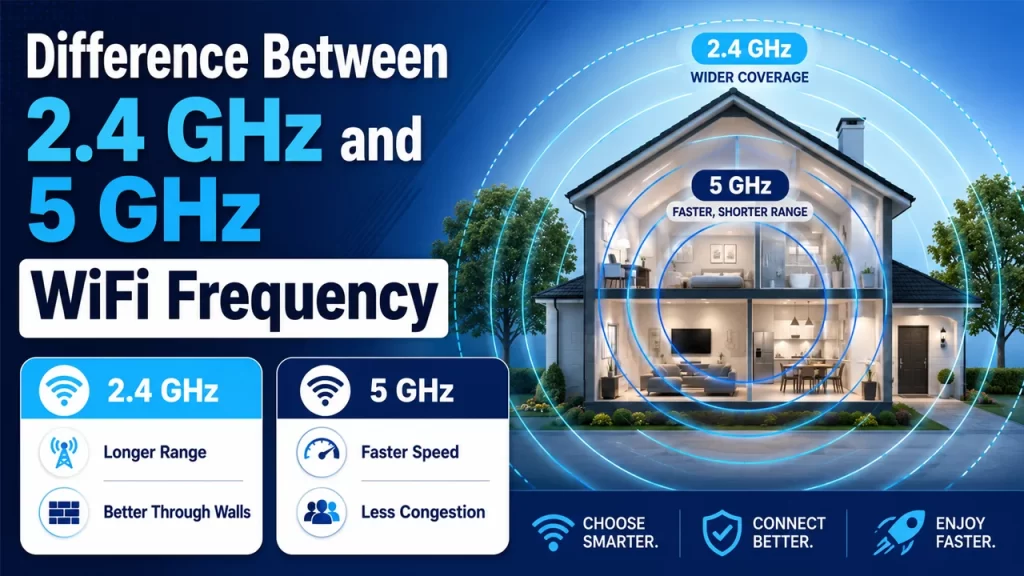
Main Difference Between 2.4 GHz and 5 GHz Frequency
The main difference between 2.4 GHz and 5 GHz frequencies is speed and range. The 2.4 GHz band gives better coverage over a longer distance, while the 5 GHz band provides faster internet speed but works best at a shorter range.
Speed Comparison
- 2.4 GHz offers a slower internet speed compared to 5 GHz.
- 5 GHz provides faster data transfer and smoother performance.
- 2.4 GHz is good for basic browsing, emails, and social media.
- 5 GHz is better for HD streaming, online gaming, and large downloads.
- If your device is close to the router, 5 GHz usually gives better speed.
Range Comparison
- 2.4 GHz has a longer transmission range.
- It can pass through walls, doors, and furniture more easily.
- 5 GHz has a shorter range and works best near the router.
- 2.4 GHz is better for large homes or rooms far from the router.
- 5 GHz is ideal for same-room or nearby device connections.
Interference and Overcrowding
- 2.4 GHz is more crowded because many devices use this band.
- Bluetooth devices, microwaves, baby monitors, and nearby routers can cause interference.
- 5 GHz is usually less crowded and cleaner.
- 5 GHz has more available channels, which helps reduce signal conflicts.
- In busy areas like apartments, 5 GHz often performs more smoothly.
Latency and Performance
- 2.4 GHz may have higher latency because of interference and overcrowding.
- Higher latency can affect online gaming, video calls, and live streaming.
- 5 GHz usually offers lower latency and faster response time.
- It gives better performance for gaming, streaming, and real-time internet use.
- For the best performance, use 5 GHz when you are close to your wireless router.
2.4 GHz vs 5 GHz: Which One Should You Use?
You should use 2.4 GHz when you need better Wi-Fi coverage over a longer distance, and use 5 GHz when you want faster speed near the router. Both frequency bands are useful, but the best choice depends on your device location, internet usage, and signal strength.
- Use 2.4 GHz for longer range and better wall penetration.
- Use 2.4 GHz for smart devices, printers, cameras, and basic browsing.
- Use 5 GHz for faster internet speed and smoother performance.
- Use 5 GHz for online gaming, HD streaming, video calls, and large downloads.
- Choose 2.4 GHz if your room is far from the wireless router.
- Choose 5 GHz if your device is close to the router.
- Use both bands if your router supports dual-band Wi-Fi.
- Rename both Wi-Fi bands clearly, such as “Home WiFi 2.4G” and “Home WiFi 5G,” so you can connect to the right one easily.
Final Thoughts
The difference between 2.4 GHz and 5 GHz frequency mainly comes down to speed, range, and interference. The 2.4 GHz band is better for long-distance coverage, while the 5 GHz band is better for fast internet speed and low latency. If you live in a large home or use Wi-Fi far from the router, 2.4 GHz can be more reliable. But if you stream videos, play online games, or download large files near the router, 5 GHz is usually the smarter choice. For the best experience, use both bands wisely and adjust your settings through the router admin panel when needed.
Frequently Asked Questions (FAQs)
What is the main difference between 2.4 GHz and 5 GHz Wi-Fi?
The main difference is that 2.4 GHz offers better range, while 5 GHz offers faster speed. 2.4 GHz is better for long-distance use, and 5 GHz is better for high-speed activities near the router.
Is 5 GHz Wi-Fi faster than 2.4 GHz?
Yes, 5 GHz Wi-Fi is usually faster than 2.4 GHz. It is better for streaming, gaming, video calls, and downloading large files, especially when your device is close to the router.
Does 2.4 GHz Wi-Fi go through walls better?
Yes, 2.4 GHz Wi-Fi passes through walls, doors, and furniture better than 5 GHz. That is why it works better in large homes or rooms far away from the router.
Which Wi-Fi band is better for gaming?
The 5 GHz band is better for gaming because it usually gives faster speed, lower latency, and less interference. However, your device should be close to the router for the best performance.
Can I use 2.4 GHz and 5 GHz at the same time?
Yes, if your wireless router supports dual-band Wi-Fi, you can use both 2.4 GHz and 5 GHz at the same time. You can connect far-away devices to 2.4 GHz and high-speed devices to 5 GHz.