
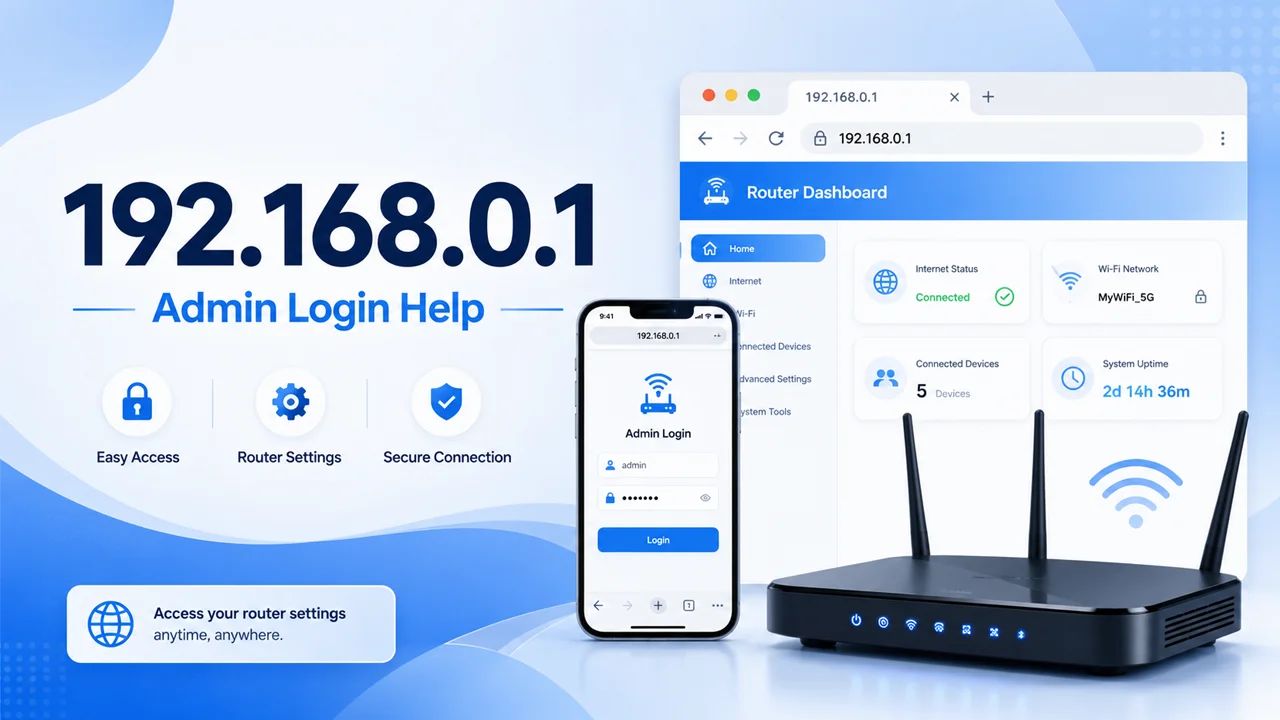
192.168.0.1 is a common private IP address used to access the router admin panel. It works as a gateway that allows users to manage their Wi-Fi network, change passwords, update the SSID, and control security settings. Many home and office routers, including brands like TP-Link and D-Link, may use this address as their default login IP. By entering 192.168.0.1 in a web browser, users can open the router settings page and customize their internet connection easily.
What Is 192.168.0.1?
192.168.0.1 is a private IP address commonly used by routers as a default gateway. It allows users to open the router admin panel and manage important network settings. Through this address, you can change your Wi-Fi name, update the password, check connected devices, and adjust LAN or wireless settings.
This IP address is mostly used inside local networks, so it does not work like a normal website on the public internet. Many router brands, including TP-Link and D-Link, may use 192.168.0.1 as their default login address. To access it, your device must be connected to the same router through Wi-Fi or an Ethernet cable.
How to Log In to the 192.168.0.1 Admin Panel
Logging in to the 192.168.0.1 admin panel is simple when your device is connected to the same router network. You can use this login page to change Wi-Fi settings, update the password, manage LAN settings, and improve router security. Make sure you type the IP address correctly in the browser address bar, not in the search box. If the page does not open, your router may be using another default gateway, like 192.168.1.1 or 10.0.0.1.
- Connect your mobile, laptop, or PC to the router through Wi-Fi or an Ethernet cable.
- Open any browser such as Chrome, Firefox, Edge, or Safari.
- Type 192.168.0.1 in the browser address bar and press Enter.
- Wait for the router login page to appear.
- Enter the router admin username and password.
- Click on Login or Sign In to open the admin dashboard.
- After login, you can manage wireless settings, SSID, password, LAN settings, and security options.
- If the login page does not load, check your router’s default gateway from the network settings.
What Can You Do Inside the Router Admin Panel?
Inside the router admin panel, you can manage almost every important setting of your internet connection. From changing your Wi-Fi password to checking connected devices, the admin panel gives you full control over your local network.
Change Wireless Settings
- Change the wireless network mode.
- Select 2.4 GHz or 5 GHz frequency bands.
- Adjust Wi-Fi channel settings for better speed.
- Enable or disable the wireless network.
- Set up a guest Wi-Fi network for visitors.
- Improve signal performance by changing wireless options.
Update SSID and Wi-Fi Password
- Change the SSID, which is your Wi-Fi network name.
- Set a strong and secure Wi-Fi password.
- Hide or show your Wi-Fi network name.
- Update old passwords to block unknown users.
- Use WPA2 or WPA3 encryption for better protection.
- Save changes and reconnect devices with the new password.
Manage LAN Settings
- Change the router’s local IP address.
- Manage DHCP settings for connected devices.
- Set a custom IP address range.
- View IPv4 and IPv6 network details.
- Assign static IP addresses to specific devices.
- Control how devices communicate inside the local network.
Configure Security Settings
- Change the router admin username and password.
- Enable firewall protection.
- Turn off remote management if not needed.
- Use strong Wi-Fi encryption.
- Disable WPS for better security.
- Update router firmware to fix security issues.
Check MAC Address and Connected Devices
- View all devices connected to your Wi-Fi network.
- Check each device’s MAC Address.
- Identify unknown or unwanted users.
- Block suspicious devices from the network.
- Use Wireless MAC Filtering for extra control.
- Monitor phones, laptops, smart TVs, and other connected devices.
Common 192.168.0.1 Login Problems
Sometimes, the 192.168.0.1 login page may not open, or the admin details may not work. This usually happens because of a wrong IP address, weak router connection, incorrect username/password, or browser-related issues. In most cases, you can fix the problem by checking your default gateway, restarting the router, or connecting through an Ethernet cable.
- Page not loading: Make sure your device is connected to the router network.
- Wrong IP address: Your router may use 192.168.1.1 or 10.0.0.1 instead of 192.168.0.1.
- Incorrect username or password: Check the router label, manual, or ISP-provided details.
- Wi-Fi connection issue: Use an Ethernet cable for a more stable connection.
- Browser cache problem: Clear your browser cache or try another browser.
- VPN or proxy enabled: Turn off VPN or proxy settings before opening the admin panel.
- Router not responding: Restart the router and try again after a few minutes.
- IP conflict: Make sure no other device is using the same IP address on the network.
Final Thoughts
192.168.0.1 is an important router IP address that helps users access the admin panel and manage their home or office network. Through this address, you can change Wi-Fi settings, update the SSID and password, check connected devices, and improve security. If the login page does not open, your router may be using another default gateway, like 192.168.1.1 or 10.0.0.1. Overall, knowing how to use 192.168.0.1 gives you better control over your internet connection and helps keep your network safe.
Frequently Asked Questions (FAQs)
What is 192.168.0.1 used for?
192.168.0.1 is used to access the router admin panel. From there, users can manage Wi-Fi settings, LAN settings, security options, passwords, and connected devices.
Why is 192.168.0.1 not opening?
The page may not open if your device is not connected to the router, the IP address is wrong, or your router uses another default gateway like 192.168.1.1 or 10.0.0.1.
Can I change my Wi-Fi password using 192.168.0.1?
Yes, you can change your Wi-Fi password by logging in to the router admin panel through 192.168.0.1 and going to the wireless settings section.
Is 192.168.0.1 the same as 192.168.1.1?
No, both are different private IP addresses. Some routers use 192.168.0.1, while others use 192.168.1.1 as their default login address.
What should I do if I forgot my router admin password?
You can check the router label or manual for default login details. If the password was changed and you do not remember it, you may need to reset the router to factory settings.